
A Mean Little Fish In A Deep, Dark Ocean
The Sword, The Crown, & The Unspeakable Power, henceforth “SCUP,” published in 2018 and written by Todd N. and Tom J., is a self-described hack of Meguey and Vincent Baker’s Apocalypse World. Per Chapter One, SCUP “is a role-playing game for 3-6 people that deals with social hierarchy, political intrigue, and violent retribution in a fantasy setting.”
A fantasy setting you say? Sweet, I love fantasy settings! So what should we know about SCUP‘s fantasy setting? Page two gives the reader this description (emphasis mine):
The Setting
The game takes place wherever power is held in grasping fingers and fought for with blades and bribes… While SCUP is a fantasy game, it isn’t about slaying dragons — it’s about scheming, dealing, threatening, and worse to get what you want, no matter the cost… [T]he one common thread between every game is The Unspeakable Power…[S]ome can hear it, some can see it, and some can even try to control it.
Cool, but you might notice something unusual about this setting: it doesn’t have, like, specific places and locales, or any concrete descriptions of a physical place that one typically associates with the idea of a “setting.” I’ve abbreviated the section in the above quote, which does contain some light suggestions about the physical setting, prefaced with “perhaps” and “maybe.” The only thing this setting definition is certain about is that the setting you will play in has something called The Unspeakable Power in it. The section about the game’s setting has very little to say about what it looks like or what’s in it. SCUP gives us a hefty handful of verbs for the characters to do in the setting, rather than evoking anything specific about the place itself. Characters will hold, grasp, fight, scheme, deal, and threaten. Some of them will hear, see, or control The Unspeakable Power. Wherever characters are doing those things, that’s where SCUP is set.
Most fantasy tabletop roleplaying games (TTRPGs) have at least an implied setting, and many have explicit settings with varying degrees of granular detail. Exceptions to this tend to be deliberately generic systems (Fate, GURPS). Fantasy games are rich with imagery and vivid descriptions of landscapes, structures, people, magic, even gear and equipment (sometimes especially the gear and equipment). One of the most exciting things you can drop in a fantasy nerd’s lap is a dense, glossy-printed hardcover book packed full of cool fantasy stuff. While it is common for GMs to homebrew their own fantasy settings, those fictional worlds tend to draw from a common well of setting elements that the game provides. Fantasy TTRPGs are usually bursting with excitement to share their overflowing box of fantastical toys with you. What your table will do with all of this stuff in gameplay is typically up to your table.
This is where SCUP diverges, right from the outset, from the vast majority of fantasy TTRPGs I have read or played. In its first few pages, SCUP firmly declares itself to be a game interested in the verbs of its dark fantasy roleplaying. It eschews inspiring you with descriptions of cool locations, monsters, or magic in favor of describing potent actions for characters to take. In its Powered by the Apocalypse (PbtA)-style Moves, SCUP provides mechanical support for what happens when characters partake of its favorite verbs: threaten, persuade, engage in combat, face duress, and so on.
The subjects and objects—the what, who, and how—that your play group will attach to those verbs are the game’s fruitful void. To enforce its intended themes of dark fantasy, the game simply provides you with the kinds of actions characters do in dark fantasy. I see this as a clever and potent inversion of the typical approach to enforcing genre conventions in a TTRPG. A more typical approach to a dark fantasy TTRPG would have been to fill the book with descriptions of places, objects, and people that are expected of dark fantasy, and ask the play group to use the aesthetics of its described world to guide the verbs their characters will use.
SCUP describes itself as a hack of Apocalypse World, and this is immediately clear upon reading the rules of both games. The core mechanics hew very close to the inspiration; the apple practically scrapes the tree’s bark on the way down. What I specifically want to give SCUP its gold star for is hacking Apocalypse World‘s rules into the very crowded genre of fantasy roleplaying games, like a desperate adventurer hacking their way out of the thorny undergrowth with a rusty machete. In doing so, the game is a standout example of what fantasy roleplaying can be when it’s given room to truly breathe. SCUP sets itself far enough apart to get far out of D&D‘s shadow, while remaining squarely in its chosen dark fantasy genre.
This might sound like I’m presenting SCUP as the first TTRPG to invent the concept of filling in the blanks, which is of course not true. What I’m trying to convey is how uncommonly wide the blank spaces are in SCUP‘s design, without ever losing structural integrity or losing sight of its artistic goals.
The Game I Played
When I played a campaign of SCUP, it was the first time I had played a PbtA game and the farthest I’d ventured outside of the familiarity of Dungeons & Dragons, Pathfinder, and similar games. We followed the book’s procedures for setting up a game, which include collaboratively creating a mythology for our setting and inventing Factions that our characters would belong to. This process is where the first and most important steps of filling in the necessary nouns for the campaign’s setting happened. Mythology describes the commonly-understood big picture lore of the setting, and the Factions are the best way for players to author their own corner of the setting. Simply by giving me, as a player, this amount of authorship over the game’s setting (my Faction was a loose fellowship of magic-users called the Salt), the game gave me a foothold for becoming more invested in everything else that happened.
We collectively described an island city-state, once a battleground for followers of the Old Ways and the new would-be rulers, a race of Titans. Both the high priests of the Old Ways and the Titans had suddenly vanished in recent history, leaving behind a society no longer in a state of open war, but still in great tension. The one Old Power that remained was the very thing that surrounded our island on all sides: the Deep, our Unspeakable Power. My character, Talus, was an Adept (SCUP‘s mage-like class) who could harness bits of the Deep’s power.
Right from the outset, SCUP (and our GM) allowed me to have incredible agency to describe almost everything about Talus’s magic: how it looked, how it sounded, what tools I used to cast it (if any). As long as the details I made up were consistent with the established fiction and adhered to the limits prescribed by the game’s Moves, the sky was the limit.
I leaned into the themes of the Deep as the Unspeakable Power at every opportunity, inventing a kind of ocean-themed hedge wizard. As long as I didn’t claim that my spells duplicated the effects of other abilities specifically defined elsewhere in the book, I could narrate damn near any effect I wanted that respected the verbs prescribed by the game. When threatening a nobleman early in the campaign, Talus Harnessed the Unspeakable Power to transmute the victim’s saliva into seawater, just as a flex. When I picked the option to use magic in combat, a Move titled Arcane Malice, I invented a spell that Talus used to invoke the crushing pressure of the unfathomable depths of the ocean. With this awful means of inflicting damage, Talus racked up the highest body count of any player character in the campaign, despite arguably having the most altruistic (kinda) intentions.
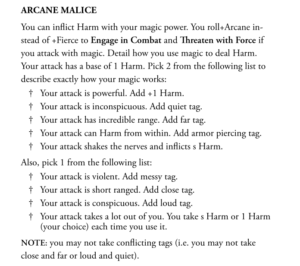
Arcane Malice is the one way for a character to directly attack, physically, with magic. As long as your spell meets these parameters and suits the fiction, you can make it anything at all.
A Note About Factions
SCUP has the following to say about Factions, on page 152:
Power is about social relationships between people and groups. A boss needs employees, a queen needs subjects, and a pastor needs a congregation…. To be positioned in a social group is to have people to defend you and resources to help you achieve your goals. Being embedded in a social group also comes with responsibilities. To stay in a group, you must maintain positive relationships with other members. The power of being a group member comes with the price that all social relationships come with: responsibilities to those you are connected to.
Before I get into anecdotes, I want to highlight this as one of SCUP‘s many powerful statements about its priorities. Power in this game is not a number on your character sheet, an amount of treasure (or any physical object), magic spells, or unique skills. Power is who you know, and who knows you. Everything else is a prop. One of the game’s Moves, available to any PC, is literally called “Do You Know Who I Am?” While loot and filthy lucre will very likely come into play in a game of SCUP, it’s the Factions that will do the most to shape the setting and shape your characters. For that reason, I think, Factions is one of the few bits of this rulebook that actually contains a handful of specific, genre-flavored nouns. Just barely enough to keep you on-theme, but not enough for any two campaigns of SCUP to look similar to each other.
Each of us players invented, with the rest of the table’s input, the Faction our PCs were members of. We could call on them for favors and influence, limited by the game’s Honor mechanics, and the Factions in turn would require us to do certain things to keep them happy. Talus was a member of the aforementioned Salt, who were social outcasts from the formal order of society but had deep roots in the city’s lower classes. The Bloodletter (a grim, experimental healer) character was a member of the Doctor’s Guild, the Voice (the social and political puppetmaster) had their clique of affluent information brokers, and the Beloved (someone with a special and unsettling personal connection to the Unspeakable Power) was the heir to an old noble family.
These Factions, and therefore the society and wider world their existence implied, were built using the guides on page 153, which provides a list of loosely defined options for the Faction’s overall kind (clan, guild, order, etc), status (noble, common, outlaw, etc), and a list of Faction benefits for each one based on their social status. High-status Factions might have access to “wealth” or “knowledge”, while common Factions have benefits like “numbers” or “inconspicuousness,” and outcast or outlaw Factions could have “blackmail” or “contraband.”
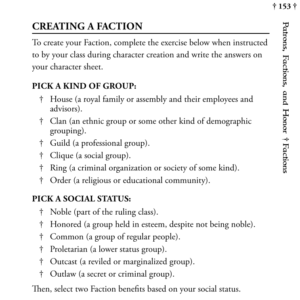
This two-page section for building Factions might be the most that SCUP ever does to provide specific nouns for the table to use, and the list options are either single-word or very short descriptions. In practice, the players and GM at the table still have a lot of latitude to decide what those Faction benefits actually look like. If your character in SCUP belongs to a Faction with “Blackmail” as a benefit, and you spend the Honor to get a good result on your Call on Your Faction dice roll, then blackmail is, per the rules, something your Faction can do on your behalf. But blackmail isn’t something that just happens on a whim: What back channels will the blackmail travel to get to the recipient? Who are you handing the task off to? What methods are used to obscure the source of the blackmail? What will you use as leverage against the recipient? So long as your answers don’t violate the established fiction (no sending blackmail via emails in a world without computers), any answer to these specifics and particularities is valid. Your social capital within your Faction ensures that it will be taken care of. In a more traditional TTRPG, answering these questions could involve burning a whole lot of shoe leather, requiring the player to find back channels, people, and methods already existing or improvised by the GM. Ultimately it may end up being too much fuss to go through with the cool blackmail plot, and the PC resorts to bonking their target on the head with a +2 sock of nickels, because at least the game has rules for that.
More Stuff We Did
Rather than bludgeon you with paragraphs of stories about my cool RPG character, I’ll try to rapid-fire through the arc Talus followed. The shortest possible description would be Rags to Riches to Ruin, but I’ll get a little more specific than that.
In approximate order of events, Talus:
- Immediately became embroiled in a plot to commit regicide, in session one.
- Set off a factional war between his group of sorcerers and religious zealots.
- Was assaulted by visions of the Deep rising up to swallow the entire island into the sea, if its whims were not satisfied. Almost everything he did after this was, at the root, grounded by a desire to prevent this outcome.
- Briefly became a royal advisor and, in very short order, delivered the ruler right into the hands of cultists who sacrificed her to the Deep.
- Did his level best to stop a massive man-eating seaweed monster, which had claimed the title of Prince and heir to the recently-murdered ruler (it was, sctrictly speaking, her son and legitimate heir, but we don’t have time to get into that now).
- Was stabbed in the back and slain in the middle of battle by another PC, who had been the ruler’s lover. Talus transmuted into salt, toppled into the seawater that was flooding through the city streets, and dissolved away, finally claimed by the Deep.
I am leaving out enormous amounts of stuff that the other PCs did which shaped these events, of course. What I want to say with all of this is that, in fewer than 20 sessions spread out over exactly a year, our characters (who were often not in the same scenes) did more memorable stuff than any PC I’d ever played in a TTRPG campaign. Much of what I recall from old D&D games are the silly goofs, the moments the dice and mechanics resisted or foiled our attempts to be cool and dramatic. From SCUP, I remember the ways the game constantly shoved us towards being cool and dramatic.
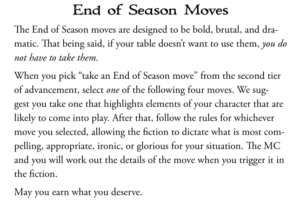
It is very likely for your SCUP characters to die in the course of a campaign. Unless you’re actively trying to die ignobly in a pit trap, the rules do everything in their power to guide your characters towards big, loud, or poignant ends.
Who’s This For?
If you’re the kind of lifelong fantasy-enjoying dweeb that I am, I hope this is starting to bubble that mental cauldron you’ve been steadily feeding fantasy ideas into over the years. And if you’re not the kind of fantasy dweeb I am, SCUP doesn’t ask you to be inspired by lavish, complicated worldbuilding. As I tried to make clear above, it just doesn’t have any worldbuilding other than what you make for yourself, as suits your tastes. If the fantasy flavor is only set dressing for the things you actually care about, like messy character drama or political intrigue, SCUP works just as well (possibly even better).
Despite all of my gushing about the magic I did with my character, SCUP is far more about the back-and-forth of ambitious, driven, relentless characters than about casting spells, or swinging swords. It’s a game for making and breaking oaths, seizing opportunities that weren’t meant for you, and straining at the limits imposed on you by status and social hierarchies until either you or those limits burst. The reason your PCs cast those spells, swing those swords, or skulk in those shadows is because fuck ’em, I tried asking nicely.
The real trick SCUP pulled was getting a fantasy dweeb like me to pour my mental cauldron of fun ideas into its mold of PbtA-style narrative gameplay. I didn’t just make a character with cool stuff on his character sheet and then toss him around a fantasy sandbox. I made a scrappy little dude who wanted something, who learned just how badly other forces in the world didn’t want him to have it, and who decided to find out just how far above his weight he could punch (quite far, as it turned out). That’s a narrative arc which is not at all exclusive to fantasy, but god damn it works really well there.